Satelit baru Terminal 1 dibangun dari kayu cedar, oak dan larch Jepang. Sejak 1 Oktober, koridornya juga berbau seperti hutan: tiga racikan, hutan selatan, hutan utara dan hutan Haneda, berganti pelan sepanjang jalan penumpang menuju gerbang. Pengelola bandara mengujinya tiga bulan dulu di Terminal 2.
Ditulis oleh tim ShizenSumber: Japan Airport Terminal dan TS Aromatique, 24 September 2026 · Nikkei · SoraNews24 · PromotoolSemua artikel InsightTerjemahan Bahasa Indonesia oleh tim Shizen dari artikel asli berbahasa Jepang.
Koridor kayu satelit utara Terminal 1 Haneda, tempat tiga aroma hutan dipasang sejak 1 Oktober 2026. Foto: Japan Airport Terminal / TS Aromatique (rilis pers).
3aroma hutan di satu koridorTerminal 1, gerbang 24–29
1 Okt 2026aroma mulai dipasangsebulan setelah satelit dibuka
3 bulanuji coba sebelum pemasanganTerminal 2, April–Juni 2026
Haneda, bandara utama Tokyo, membuka satelit utara Terminal 1 pada 1 September 2026: perluasan besar pertama terminal itu sejak 1993, dengan enam garbarata dan lantai atas yang dibangun dari kayu cedar, oak dan larch Jepang.4 Sebulan kemudian pengelolanya, Japan Airport Terminal, menambahkan lapisan yang tidak terlihat. Sejak 1 Oktober, koridor penghubung dan area gerbang 24–29 diberi tiga aroma yang terinspirasi hutan Jepang, dari minyak aroma 100% alami tumbuhan Jepang.1 Tujuannya, tulis Nikkei, bukan hanya pengalaman penumpang, tetapi juga mengurangi stres orang yang bekerja di sana.3
Tiga hutan dalam satu koridor
Aromanya berganti pelan sepanjang jalan ke gerbang.
Racikannya dibuat TS Aromatique, studio aroma Tomoko Saito di Shibuya, Tokyo. “Hutan selatan” memakai hinoki, kamper hōshō dari Kagoshima, sugi dan yuzu, dan digambarkan kuat serta terang. “Hutan utara” memakai hinoki, cemara todomatsu Hokkaido, hiba dan mint Jepang: kesegaran pohon jarum di udara dingin yang jernih. “Hutan Haneda” menyatukan pohon-pohon yang paling identik dengan Jepang, hinoki, pinus merah, cemara, sugi dan yuzu.1 Ketiganya disusun mengikuti arah jalan penumpang, dari koridor penghubung sampai ruang tunggu gerbang, sehingga aroma berpindah perlahan seiring orang berjalan.2
Yang paling menarik adalah cara studio itu menjelaskan tujuannya. Di Instagram, timnya menulis bahwa aroma tidak “ditambahkan” ke ruang, melainkan diselaraskan dengan arsitektur, kayu, tanaman, cahaya, pemandangan dan gerak orang. Targetnya aroma yang “belum sampai disadari”: orang hanya merasa ada pepohonan di dekatnya, dan napasnya tanpa sadar sedikit lebih dalam.5
Aroma yang “belum sampai disadari”: orang hanya merasa ada pepohonan di dekatnya.
Diuji dulu, baru dipasang
Tiga bulan percobaan di pemeriksaan keamanan Terminal 2.
Pemasangan ini bukan keputusan dadakan. Japan Airport Terminal menjalankan terminal.0 HANEDA, pusat riset bandara tempat 36 perusahaan, dua lembaga dan dua universitas bekerja sama. Dari April sampai Juni 2026 mereka menguji aroma di area pemeriksaan keamanan Terminal 2. Menurut rilisnya, penumpang menilainya tinggi, dan aroma dinilai berpotensi menciptakan pengalaman bandara yang nyaman dan menambah rasa rileks.1 Nikkei menyebut pemasangan di satelit baru ini sebagai salah satu hasil riset itu, dan kedua perusahaan akan melanjutkannya bersama.3
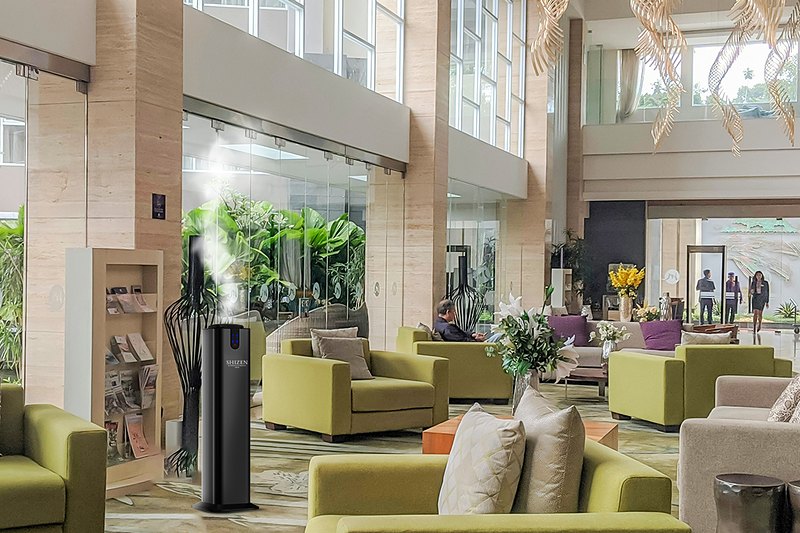
Shizen SBA2 di sebuah lounge atrium. Ruang besar berlangit-langit kayu dan bertanaman adalah tempat aroma hutan dan kayu paling terasa wajar. Visual: Shizen.
Urutannya patut ditiru: uji di satu titik, ukur tanggapan orang, lalu pasang di ruang yang arsitekturnya mendukung. Bandara memilih hutan karena bangunannya kayu. Aroma dan material bercerita hal yang sama.
Bukan hanya bandara
Bisnis aroma ruang di Jepang terus tumbuh.
Haneda adalah contoh yang paling terlihat, bukan satu-satunya. Promotool, perusahaan aroma ruang di Tokyo dengan lebih dari 4.000 perusahaan klien, melaporkan penjualan “desain aroma ruang” pada Agustus 2026 naik 13,9% dari tahun sebelumnya, didorong permintaan hotel, fasilitas komersial, showroom dan kantor.6 Di Indonesia, ruang publik berukuran besar, lobi menara perkantoran, mal, bandara, rumah sakit, adalah tempat aroma paling jarang dirancang, dan paling terasa ketika dirancang dengan baik.
Apa artinya untuk ruang Anda
Untuk lobi, mal dan gedung besar di Indonesia.
1
Rancang untuk perjalanan orang, bukan satu ruangan.
Haneda menyusun tiga aroma sepanjang koridor sampai gerbang. Di sebuah menara kantor, jalur yang sama adalah lobi, area lift dan koridor lantai. Satu keluarga aroma di sepanjang jalur itu, dengan intensitas berbeda di tiap titik. Untuk volume sebesar ini, satu unit SBV1 lewat AC sentral mencakup sampai 1.500 m².
2
Uji tiga bulan di satu titik dulu.
Pengelola Haneda menguji di pemeriksaan keamanan Terminal 2 sebelum memasang permanen. Mulai dari lobi atau satu lantai, catat komentar penghuni dan tamu, lalu perluas. Survei ruang dan uji dua–tiga aroma Shizen adalah versi kecil dari langkah yang sama.
3
Pilih aroma yang bercerita sama dengan bangunannya.
Haneda memilih hutan karena bangunannya kayu. Lobi marmer dan kaca cocok dengan aroma bersih dan sedikit hijau; ruang kayu dan tanaman dengan hutan dan kayu; klinik dengan yang lebih lembut lagi. Aroma yang tepat terasa seperti bagian dari ruang, bukan tambahan.
Bagaimana Shizen mengerjakannya
Merek Jepang, disewa bulanan.
Shizen adalah merek Jepang — by Botanica Fragrance Japan — dengan lebih dari 100 aroma, termasuk seri yang terinspirasi hotel bintang lima. Sistemnya disewa bulanan: mesin, instalasi, fragrance oil, perawatan berkala dan penggantian unit termasuk, kontrak minimum 12 bulan. Survei ruang gratis, tanpa komitmen.
Harga paket per September 2026. Enam paket lengkap, sampai 2.000 m², ada di halaman utama.
Sumber dan catatan
Dari mana angka-angka ini.
Japan Airport Terminal Co., Ltd. (press release), 24 September 2026 (PDF): area, tanggal mulai, tiga racikan dan bahannya, uji coba April–Juni 2026 di Terminal 2, dan jumlah peserta terminal.0 HANEDA diambil dari rilis ini.
TS Aromatique (PR TIMES), 24 September 2026: rilis studio tentang konsep tiga hutan dan susunannya sepanjang jalur penumpang. Foto koridor di artikel ini berasal dari rilis yang sama.
Nihon Keizai Shimbun, 24 September 2026: tujuan pemasangan (pengalaman penumpang dan stres pekerja), lokasi studio, dan kaitannya dengan riset terminal.0 HANEDA.
SoraNews24, 28 Agustus 2026: pembukaan satelit utara pada 1 September 2026, kayu cedar/oak/larch, enam garbarata, perluasan besar pertama sejak 1993.
Instagram (studio team post), 25 September 2026: unggahan tim studio tentang aroma yang “belum sampai disadari” dan keselarasan dengan arsitektur; dikutip sebagai pernyataan studio.
Promotool Co., Ltd. (PR TIMES), 18 September 2026: penjualan desain aroma ruang Promotool pada Agustus 2026 naik 13,9% dari tahun sebelumnya; lebih dari 4.000 perusahaan klien.
Shizen tidak berafiliasi dengan perusahaan, media atau peneliti yang disebut di artikel ini; mereka disebut sebagai sumber.
Efek aroma pada suasana ruang bergantung pada ruang, intensitas dan aroma yang dipilih. Karena itu kami selalu mulai dengan survei ruang dan uji dua–tiga aroma.
Terminal 1’s new satellite is built from Japanese cedar, oak and larch. Since 1 October its corridor also smells like a forest: three blends, the southern forest, the northern forest and the Haneda forest, shift slowly as passengers walk to the gates. The airport operator tested the idea for three months at Terminal 2 first.
Written by the Shizen teamSources: Japan Airport Terminal and TS Aromatique, 24 September 2026 · Nikkei · SoraNews24 · PromotoolAll Insight articlesEnglish translation by the Shizen team of the original article in Japanese.
The wooden corridor of Haneda Terminal 1’s North Satellite, scented with three forest blends since 1 October 2026. Photo: Japan Airport Terminal / TS Aromatique (press release).
3forest scents in one corridorTerminal 1, gates 24–29
1 Oct 2026scenting begana month after the satellite opened
3 monthsof trials before installationTerminal 2, April–June 2026
Haneda, Tokyo’s main airport, opened the North Satellite of Terminal 1 on 1 September 2026: the terminal’s first major expansion since 1993, with six fixed boarding bridges and an upper floor built from Japanese cedar, oak and larch.4 A month later its operator, Japan Airport Terminal, added a layer you cannot see. Since 1 October the connecting corridor and the gate 24–29 area carry three scents inspired by Japan’s forests, made from 100% natural aroma oils of Japanese plants.1 The aim, Nikkei wrote, is not only the passengers’ experience but also less stress for the people who work there.3
Three forests in one corridor
The scent shifts slowly on the way to the gate.
The blends are by TS Aromatique, Tomoko Saito’s scent studio in Shibuya, Tokyo. The “southern forest” uses hinoki, hōshō camphor from Kagoshima, sugi cedar and yuzu, and is described as strong and bright. The “northern forest” uses hinoki, Hokkaido todomatsu fir, hiba and Japanese mint: the green freshness of conifers in cool, clear air. The “Haneda forest” brings together the trees most identified with Japan, hinoki, red pine, spruce, sugi and yuzu.1 The three are laid out along the passenger’s path, from the connecting corridor to the gate lounge, so the scent changes slowly as people walk.2
The most interesting part is how the studio explains its aim. On Instagram its team wrote that scent is not “added” to a space but brought into harmony with the architecture, the wood, the planting, the light, the view and the movement of people. The target is a scent “just below noticing”: people merely sense trees nearby, and their breathing deepens a little without their realising it.5
A scent “just below noticing”: people merely sense trees nearby.
Tested first, then installed
Three months of trials at Terminal 2 security.
This was not a snap decision. Japan Airport Terminal runs terminal.0 HANEDA, an airport research hub where 36 companies, two organisations and two universities work together. From April to June 2026 they trialled scent at the Terminal 2 security area. According to the release, passengers rated it highly, and scent was judged to have the potential to create a comfortable airport experience and improve relaxation.1 Nikkei calls the installation in the new satellite one of the results of that research, and the two companies will continue it together.3
A Shizen SBA2 in an atrium lounge. Large rooms with wood and greenery are where forest and wood scents feel most natural. Image: Shizen.
The order is worth copying: test in one spot, measure how people respond, then install where the architecture supports it. The airport chose forest because the building is wood. Scent and material tell the same story.
Not only airports
Japan’s space-scenting business keeps growing.
Haneda is the most visible example, not the only one. Promotool, a Tokyo scent company with more than 4,000 corporate clients, reported that its “scent space design” sales in August 2026 were up 13.9% on the year, driven by demand from hotels, commercial facilities, showrooms and offices.6 In Indonesia, large public spaces, office-tower lobbies, malls, airports, hospitals, are where scent is least often designed, and where it is felt most when it is designed well.
What it means for your space
For lobbies, malls and large buildings in Indonesia.
1
Design for the journey, not for one room.
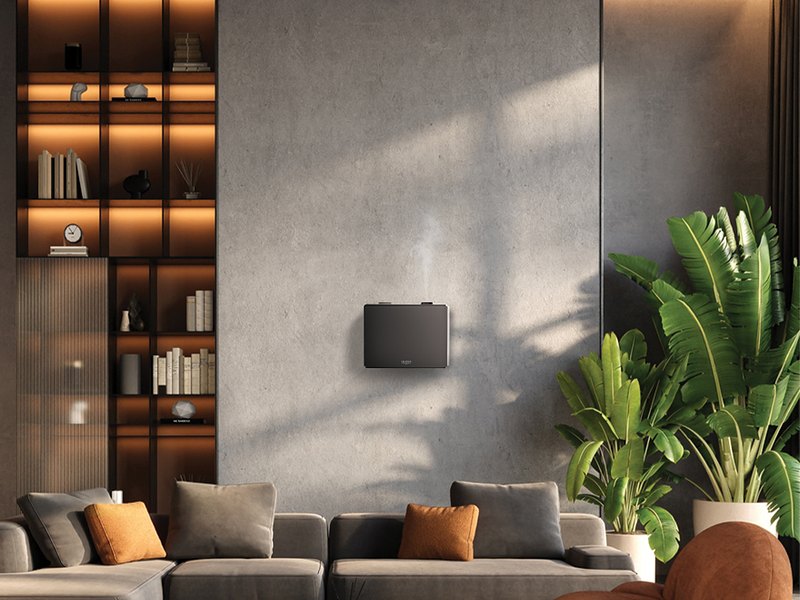
Haneda laid out three scents from the corridor to the gates. In an office tower the same path is the lobby, the lift lobby and the floor corridors. One family of scents along that path, at a different intensity at each point. For volumes this size, one SBV1 on the central air-conditioning covers up to 1,500 m².
2
Trial three months in one spot first.
Haneda’s operator tested at Terminal 2 security before installing for good. Start with the lobby or one floor, note what staff and visitors say, then extend. Shizen’s site survey and trial of two or three scents is a small version of the same step.
3
Choose a scent that tells the same story as the building.
Haneda chose forest because the building is wood. A marble-and-glass lobby suits a clean, slightly green scent; rooms of wood and plants suit forest and wood; clinics something softer still. The right scent feels like part of the space, not an addition.
How Shizen does it
A Japanese brand, rented monthly.
Shizen is a Japanese brand — by Botanica Fragrance Japan — with more than 100 fragrances, including a series inspired by five-star hotels. The system is rented monthly: machine, installation, fragrance oil, regular servicing and unit replacement included, minimum contract 12 months. A free site survey, no commitment.
Plan prices as of September 2026. All six plans, up to 2,000 m², are on the home page.
Sources and notes
Where these figures come from.
Japan Airport Terminal Co., Ltd. (press release), 24 September 2026 (PDF): the areas, start date, the three blends and their materials, the April–June 2026 trial at Terminal 2 and the terminal.0 HANEDA membership are taken from this release.
TS Aromatique (PR TIMES), 24 September 2026: the studio’s release on the three-forest concept and its layout along the passenger path. The corridor photo in this article comes from the same release.
Nihon Keizai Shimbun, 24 September 2026: the stated aims (passenger experience and workers’ stress), the studio’s location and the link to the terminal.0 HANEDA research.
SoraNews24, 28 August 2026: the North Satellite’s opening on 1 September 2026, cedar/oak/larch construction, six boarding bridges, first major expansion since 1993.
Instagram (studio team post), 25 September 2026: the studio team’s post on scent “just below noticing” and harmony with architecture; quoted as the studio’s own statement.
Promotool Co., Ltd. (PR TIMES), 18 September 2026: Promotool’s scent-space-design sales in August 2026 up 13.9% on the year; more than 4,000 corporate clients.
Shizen is not affiliated with the companies, media or researchers named in this article; they are cited as sources.
The effect of a scent on a space depends on the room, the intensity and the fragrance chosen. That is why we always start with a site survey and a trial of two or three scents.