Insight5 min read

A nature scent: better memory, 38.8% less cheating.

Put 256 people in a room, give some of them a view of greenery, some a faint woodland scent, some both, and watch six paid tasks. That is what a Texas A&M team did. The view sharpened attention. The scent, on its own, improved memory and cut cheating by 38.8%. The authors are careful about what it means; so are we.

Written by the Shizen teamSource: Frontiers in Psychology, 13 July 2026 (Texas A&M University)All Insight articlesOriginal article in English. Also available in Bahasa Indonesia and Japanese.
Reading room with a grey sofa, a wall of bookshelves and a Shizen SBX1 on the coffee table, with trees outside the window
A Shizen SBX1 in a reading room with trees outside the window. A view of greenery and a scent, the two things this study tested, in one room. Visual: Shizen.
256participants, four groupsview × scent, present or absent
2.5 → 3.6words recalled, control vs scent onlymemory test, p = 0.007
−38.8%dishonest reporting with scent aloneincentivised task, p < 0.001

A team at Texas A&M University asked a plain question: when a room gets a view of greenery, a nature scent, or both, what changes in how people work? They split 256 university students into four groups and had them work through six incentivised tasks in a fixed order: a mental-arithmetic stress test, a letter search for attention, a word list for memory, matrix puzzles for reasoning, a lottery choice for risk, and a reporting task in which cheating paid.1 The scent was a commercial fragrance called “Walk in the Woods”, bergamot on top, amber, woods and musk underneath, diffused at about 2 parts per million. The authors say so plainly: a nature-associated stimulus, not a forest.1

Scent and memory

The scent group recalled 3.6 words; the control group 2.5.

Memory moved with scent. Recall averaged 2.51 words in the control group and 3.56 in the scent-only group, a difference the authors report at p = 0.007.1 Attention moved with the view: 1.89 against 2.27 on the letter task, p < 0.001.1 The two did not simply add up. Several interactions appeared, on attention, memory, risk and dishonesty, which the authors read as “it depends on the combination” rather than “more nature is always better”.1 Stress scores and risk aversion barely changed in any group.1

Scent and honesty

Cheating fell by 38.8% with scent alone.

The reporting task paid for results that could not be checked, so over-reporting was a measure of dishonesty. Control participants over-reported 2.55 on average; the scent-only group 1.56, which is 38.8% less; the group with both view and scent 1.95, 23.5% less.1 The authors do not claim a mechanism. They note that moral cognition was not measured, and they present the finding as something to test again rather than a rule.1

Scent alone cut dishonest reporting by 38.8% — a result the authors call one to test again, not a rule.
What a careful reader keeps

Students, a laboratory, one scent.

The limits are stated in the paper and worth repeating. The participants were university students, not office workers. The tasks were laboratory tasks, shorter and simpler than real work. The scent was one commercial fragrance, not the air of a forest. And the effects are small to moderate in size, the kind that shows up across 256 people but may not show up in any one person.1 What the study adds to the two we wrote about earlier, which tired people are helped by which scent, and why a scent only works if the person likes it, is a third piece: a low, nature-associated scent, with no view at all, changed memory and honesty in a controlled room.
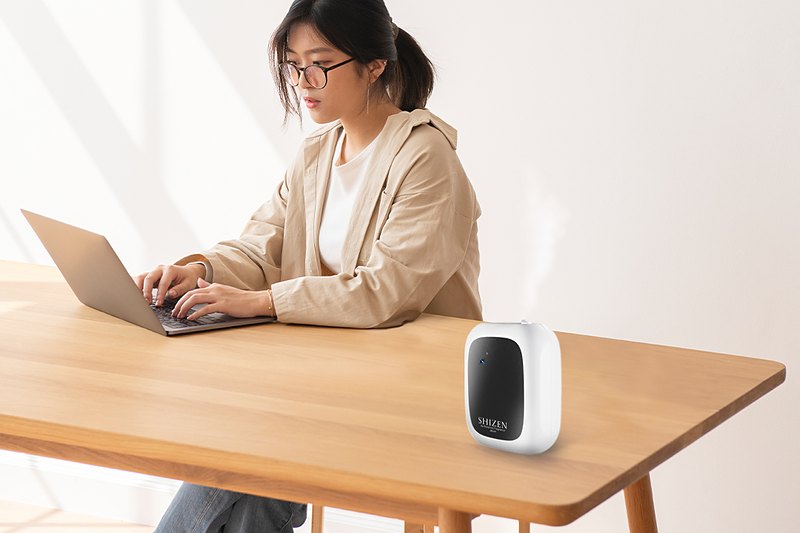
A woman working on a laptop at a wooden table, with a Shizen SBX1 on the table beside her
A Shizen SBX1 on a work table. The reporting task in the study is ordinary desk work: figures someone reports that nobody checks. Visual: Shizen.
For offices in Indonesia

Where recall and honesty matter.

The rooms this speaks to are specific: meeting rooms where decisions are taken, training and examination rooms, receptions and reading rooms where people must remember what they were told, and any desk where someone reports numbers that nobody checks. The study’s 2 parts per million is a scent you barely notice, which is also how Shizen schedules a room, by the hour and at low intensity. And the interactions are a reminder to test a view of plants and a scent together in your own room rather than assume they add up.

What it means for your space

For offices, meeting rooms and training rooms in Indonesia.

1

Put the scent where people remember and decide.

Meeting rooms, training rooms, receptions and reading rooms first. An SBX1 covers a meeting room; an SBA1 through the air conditioning covers a training floor. Keep the same scent in those rooms so that it becomes part of how the room feels, not an event.

2

Keep it faint.

The study worked at about 2 parts per million, a level most people do not consciously notice. Shizen units are scheduled by the hour and set to low intensity for exactly this reason: the aim is a room that feels right, not a room that smells of something.

3

Test a view and a scent together, in your room.

The study’s interactions mean plants, windows and scent do not simply add up. Try two or three Shizen scents in the room as it is, with its plants and its light, during the free site survey, and keep the one the people who use the room prefer.

How Shizen does it

A Japanese brand, rented monthly.

Shizen is a Japanese brand — by Botanica Fragrance Japan — with more than 100 fragrances, including a series inspired by five-star hotels. The system is rented monthly: machine, installation, fragrance oil, regular servicing and unit replacement included, minimum contract 12 months. A free site survey, no commitment.

Portable · SBX115–30 m²Rp597,000 / monthboutiques, clinics, meeting rooms, reception desks
Cozy · SBA181–200 m²Rp998,000 / monthrestaurants, showrooms, retail floors, gyms
Prestige · SBA2201–300 m²Rp1,186,000 / monthhotel lobbies, executive offices, flagship boutiques

Plan prices as of September 2026. All six plans, up to 2,000 m², are on the home page.

Shizen SBA2
Sources and notes

Where these figures come from.

  1. Frontiers in Psychology, 17:1872507, published 13 July 2026 (online 22 June 2026), “An experimental study of the acute effects of visual and olfactory nature stimuli on task performance”, Sarayu Chandra Mouli, Marco Palma, Suma Katabattuni and Jay E. Maddock, Texas A&M University; open access. All figures in this article (sample, conditions, scent, task means, p values, effect sizes, limitations) are taken from the paper.
  2. Shizen is not affiliated with the companies, media or researchers named in this article; they are cited as sources.
  3. The effect of a scent on a space depends on the room, the intensity and the fragrance chosen. That is why we always start with a site survey and a trial of two or three scents.